
Searching Kalawao County Civil Dockets
Start with the official eCourt Kōkua entry page. Know the exact case ID? Enter it there. A party-name or organization-name search also works, but check spellings and identity against the court, the case type, the filing date, and each party's role before trusting a match. When the filters let you, pick Second Circuit and Molokaʻi.
The docket search is not confined to one screen. Molokaʻi District Court answers District civil inquiries by phone and at its counter, while the Hoapili Hale Legal Documents Branch holds the Circuit records and takes written copy requests. Ask for the exact judgment, motion, or order by name. Include its filing date and the full case ID. Details like these keep the clerk from pulling a docket entry that merely describes a filing rather than the document itself. Fax and mail both work for written requests. Courthouse terminals allow free on-screen viewing, though Molokaʻi access is worth confirming before you drive over. Parties registered in their own cases can turn to JEFS for available documents.
- Open eCourt Kōkua from the stable Judiciary page.
- Select civil case type and the Second Circuit or Molokaʻi location.
- Search the complete case ID, party, or business name.
- Verify the division and read Case Dockets in date order.
- Contact the proper clerk for an absent or certified filing.
Choose the Kalawao Civil Court
Court codes route a Kalawao civil docket request to the right desk. District civil and small-claims files tied to Molokaʻi may carry 2D / ML. Circuit matters use 2C. Family matters may show 2F / ML, though confidential categories stay out of public results. Kalawao itself has no selectable county clerk system.
| Court | Civil role | Custodian |
|---|---|---|
| Molokaʻi District Court | Small claims, summary possession, and District civil claims up to $40,000; specified performance up to $20,000 | Molokaʻi District clerk |
| Second Circuit Court | Major civil, probate, and assigned equitable or statutory matters | Legal Documents Branch, Hoapili Hale |
| Second Circuit Family Court | Domestic and family matters, subject to confidentiality | Family Court clerk |
Pick the correct court level first. That choice prevents a false no-result and sends your copy request to the clerk who actually holds the record.
Inside a Kalawao County Civil Docket
A civil docket is the case's chronological index, not the full text of every paper. It lists parties by role. It logs each event: complaint, service, answer, motion, hearing, order, judgment, appeal. An entry only marks a moment. Match it against what happens next. A filed motion is not a granted one until a later order says so.
| Case ID | Court, location, civil case type, year, and sequence. |
|---|---|
| Parties | Plaintiff, petitioner, defendant, respondent, and other roles. |
| Chronology | Complaint, service, answer, motions, hearings, orders, and judgment. |
| Settings | Hearing date, time, type, and location when entered. |
| Status | Overall open or closed state, not the terms of judgment. |
| PDF icon | An available public document image sold separately from free docket text. |
The Judiciary’s court-record access options show the online, courthouse, and written routes.
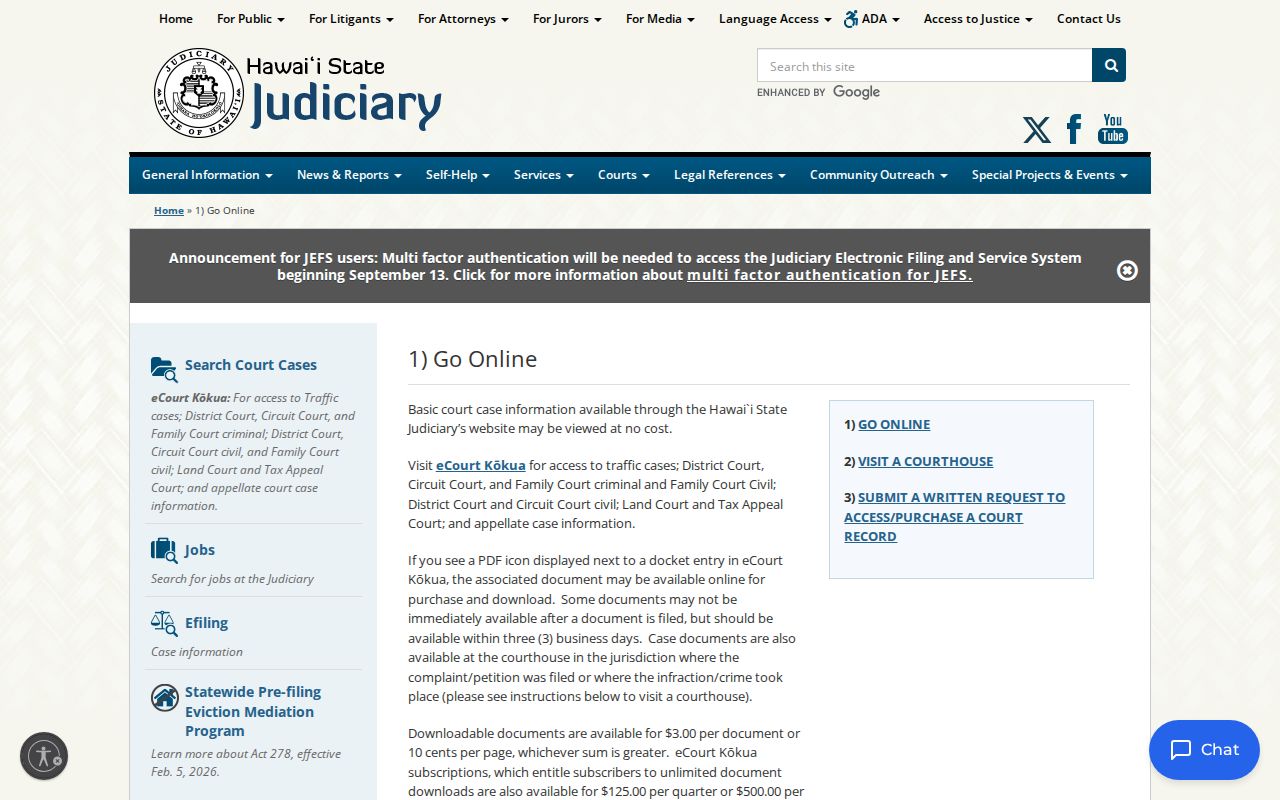
A filing absent from the online Kalawao County civil docket has not vanished. The clerk can still produce it on request.
Read Kalawao Civil Events in Sequence
Begin at the beginning. Find the initiating complaint or petition and note the case type. Service and answer entries come next. They show which sides have appeared in the Kalawao County case. Then match each motion to the later minute or order that resolves it. Work through every hearing notice and continuance before you trust any date as current. The judgment or dismissal ends the main story. Read past it for any post-judgment writ, satisfaction, or appeal.
- Service
- Delivery of papers in the legally required way.
- Answer
- The defendant’s formal response to the complaint.
- Motion
- A request for a ruling, not the ruling itself.
- Judgment
- The court’s formal determination of rights or relief.
- Satisfaction
- An entry tied to fulfillment of a judgment obligation.
A "closed" label tells you almost nothing by itself. Who prevailed, what relief was ordered, and whether enforcement followed all live in the entries after judgment, so read them.
Civil Case Types on the Docket
Subject matter and the amount in dispute decide where a Kalawao County civil case lands. Molokaʻi District Court handles lower-value civil claims, small claims, and summary-possession matters. Larger disputes, probate, and matters assigned by statute or equitable jurisdiction sit in Circuit Court. Family Court holds the domestic cases. Statutory and court-ordered confidentiality boundaries limit public access there.
- District civil claims within the court’s monetary jurisdiction
- Small-claims disputes
- Summary-possession matters
- Circuit civil and probate cases
- Public family matters where access is allowed
Kalawao County has no municipal civil court, no justice of the peace, and no elected county clerk. Hawaiʻi handles things differently, so leave mainland court labels out of any Kalawao County civil docket search.
Missing Kalawao Civil PDF Images
PDF availability has its own cutoffs, separate from docket coverage. If your District civil papers were filed before October 7, 2019, eCourt has no PDF for them. The same goes for Circuit civil documents filed before October 28, 2019. Family civil images cut off even later. So when the icon is missing, the gap may just be digitization. The case or filing can still exist.
Need a District document? Call Molokaʻi District Court at (808) 553-1100. For Circuit material, try the Legal Documents Branch at (808) 244-2752. Fax a written request to (808) 244-2932 works too. Give the case ID, the document title, and the docket date. Then wait for the invoice. Sending payment first only slows things down.
The official Second Circuit forms collection posts the local court forms.
Forms: they help with court procedures, but the clerk's instructions for a specific record request still come first.
Civil Docket Settings and Hearings
A civil date can surface in several places. Think of the docket entry. Try a published calendar, the clerk's live schedule, or a paper notice and order. Read the latest notice first, plus any continuance that came after it. A reset wipes out the earlier setting. Scheduling on Molokaʻi is rural and can cluster. Confirm the current date and whether your hearing sits in Kaunakakai or Wailuku before you travel.
Each setting means something different. One civil date might cover a motion, a conference, a trial, or another case step. Unlike a criminal arraignment, its purpose comes from the filed request and the scheduling order behind it. If what you find online conflicts, call the assigned court right away. Parties should lean on their filed notices and court communications over anything else.
Match the event description to the motion, notice, or scheduling order that produced it. A hearing on one request is not the trial of the whole dispute. A conference can sort deadlines without deciding the merits. When a later minute or order continues an event, that new entry controls. Kalawao users should read the location field rather than assume all Second Circuit work is heard on Molokaʻi. District matters may be set in Kaunakakai, while a Circuit file is administered from Wailuku. Does the portal show no room? Did the setting change after the online calendar was posted? Call the assigned clerk with the full case ID. A paper notice served on a party can carry instructions a short calendar row never shows.
Kalawao Civil Copies and Fees
Basic docket information is free, and so is terminal viewing where offered. Copies cost money. An eCourt PDF of one through 30 pages runs $3. Pages over 30 cost $0.10 each. Trial-court certification is $2 where applicable. A clerk name search without a case number may cost $5. Off-site retrieval, microfilm, mailing, and handling can add charges on top. The Circuit Court rules and fee provisions spell out the official terms. They cover Circuit searches, copies, and certification.
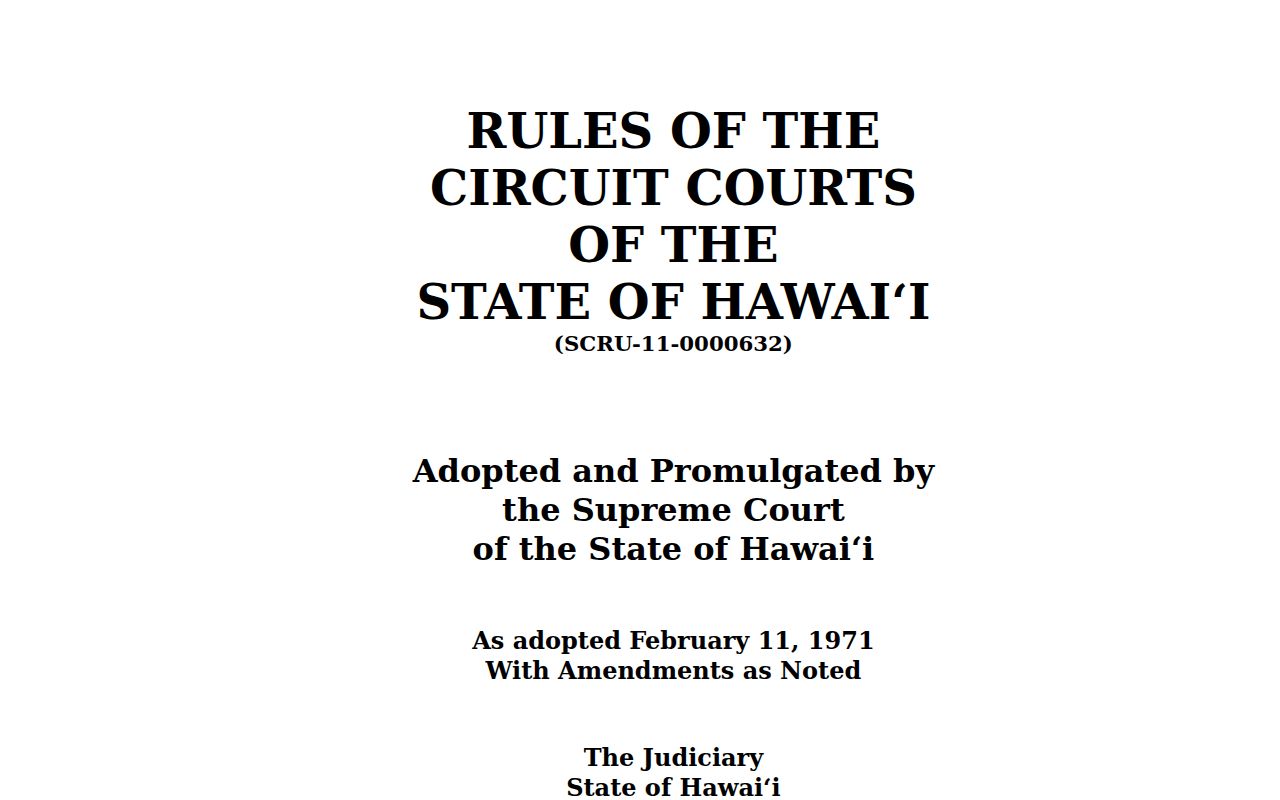
The distinction matters: an information screen is free, a copy is paid, and a clerk-certified record sits in its own category under the rules.
| Record product | Official term |
|---|---|
| Basic docket online | No charge |
| Public PDF, 1 to 30 pages | $3 |
| Each page over 30 | $0.10 |
| Certification | $2 where applicable |
| Name search without case number | $5 may be assessed |
Civil Docket Access Rules
Two rulebooks control access here. The Hawaiʻi Court Records Rules govern court-case access and clerk custody. HRS chapter 92F governs many agency records. But a court file should be requested from the court clerk, not the Department of Health. Expect public access to omit confidential family matters, sealed cases, protected fields, and older images.
Access boundary: Hawaiʻi Court Records Rules 2 through 4 and 9 through 10 address public access, confidential records, requests, clerk custody, and electronic access.
HRS chapter 92F does not turn a Judiciary case file into a Department of Health record.
Electronic fields block personal identifiers. A sealed item has no public PDF. Family categories can be excluded altogether. Authorized parties must use the court's access process, and paying for a public copy cannot override confidentiality.
No Kalawao County Civil Clerk
Kalawao County runs no civil clerk of its own. Its unusual government never built a separate court-record office. Civil filings land in the island's existing courts instead. District cases stay with Molokaʻi District Court. Circuit cases sit with the Second Circuit clerk over in Wailuku. So a single Kalawao dispute can carry Molokaʻi, Second Circuit, or Wailuku details across its paperwork. That routing is the key local fact for any docket search. Skip the hunt for a county-named court. Pull the state system. Spot the ML marker or the Second Circuit level, and send your follow-up questions straight to the office holding the file.